

Cairo Hosts Meeting of Foreign Ministers from Four Regional Partners
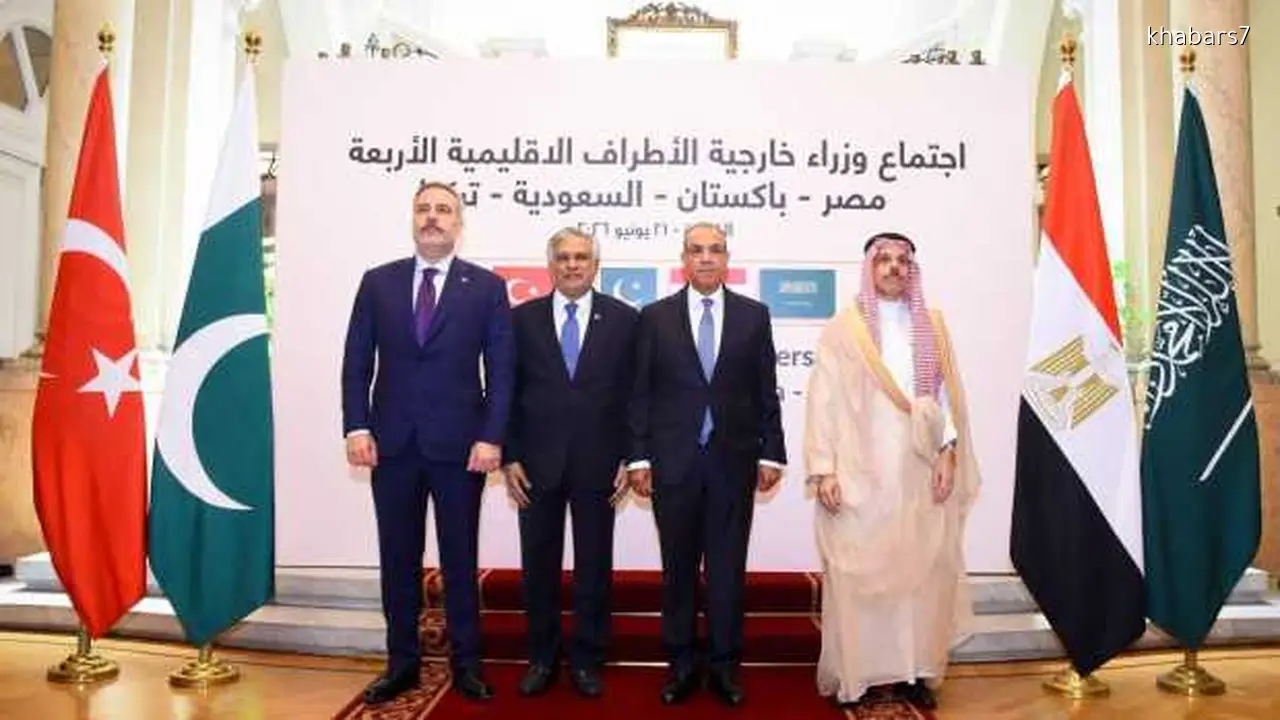
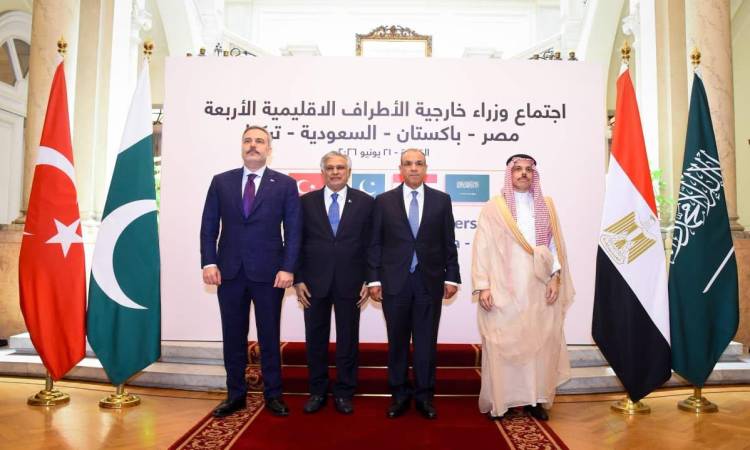
Meeting of Foreign Ministers from Four Regional Partners.
On June 21, 2026, the foreign ministers of the Arab Republic of Egypt, the Islamic Republic of Pakistan, the Kingdom of Saudi Arabia, and the Republic of Turkey convened in Cairo. The ministers expressed their deep appreciation to President Abdel Fattah El-Sisi for sharing his vision for the region’s future, which serves as a guiding light for the group’s efforts to establish stability in the Middle East.
The meeting provided an opportunity for an in-depth exchange of views on regional and international developments. The ministers emphasized the importance of continued consultation and coordination among the four countries to support peace, security, stability, and prosperity in the Middle East and beyond.
Regarding recent regional developments, the ministers particularly welcomed the signing of a memorandum of understanding in Islamabad between the United States and Iran. They viewed this significant development as a constructive step towards de-escalation and resolving conflicts that pose substantial risks to regional security and stability, as well as to energy markets, international maritime routes, global supply chains, and international trade.
In this context, the ministers commended the efforts made by regional and international parties that facilitated reaching this understanding. They stressed the importance of faithfully implementing the commitments made by all parties involved.
The ministers also praised Pakistan’s pivotal role in achieving this historic outcome and acknowledged Qatar’s support in facilitating negotiations related to the memorandum. They highlighted Pakistan’s ongoing close coordination with them on this critical issue.
Building on this positive momentum, they particularly reaffirmed the necessity of swiftly advancing to subsequent negotiation phases aimed at finding a durable, verifiable solution acceptable to all parties regarding outstanding issues.
The ministers asserted that these efforts should consider the concerns of regional states, especially concerning the security and stability of Gulf Arab countries and the Mashreq region. This would contribute to enhancing collective security and establishing long-term regional stability.
Reiterating their commitment to the centrality of the Palestinian issue in achieving peace, security, and stability in the Middle East, they stressed that addressing this matter remains at the core of efforts aimed at achieving a just, comprehensive, and lasting peace in the region. It is seen as a fundamental pillar for establishing a stable and secure regional system.
In this regard, special attention was given to both humanitarian and political situations in Gaza Strip, West Bank, and East Jerusalem under occupation.
The ministers renewed their support for the legitimate rights of the Palestinian people, including their right to self-determination and establishing an independent Palestinian state based on pre-June 1967 borders with East Jerusalem as its capital. This is considered essential for achieving a just, comprehensive, and lasting peace in accordance with relevant United Nations Security Council resolutions.
Comments