

Egypt’s Education Minister Highlights Teacher Development in Meeting with World Bank
 World Bank delegation" width="750" height="450" />
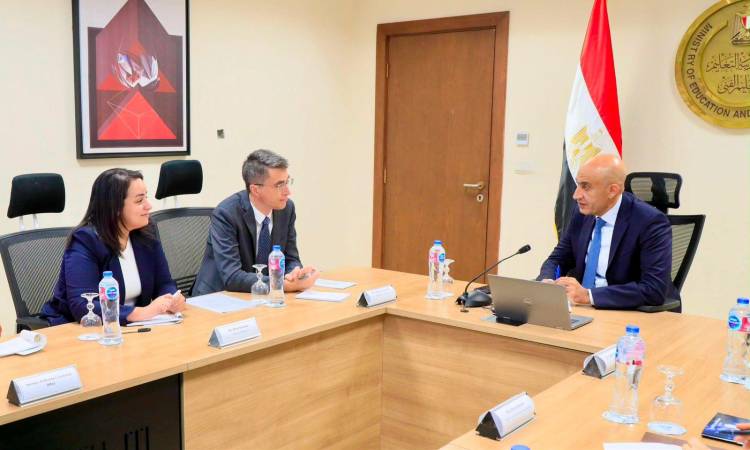
Meeting between the Minister of Education and World Bank delegation.
On Wednesday, Egyptian Minister of Education Mohamed Abdel-Latif met with Stefan Jimbert, the World Bank’s Regional Director for Egypt, Yemen, and Djibouti. The discussion focused on enhancing cooperation in various educational sectors and reviewing ongoing efforts to reform Egypt’s education system aimed at improving quality and learning outcomes.
The World Bank delegation included Miraal Shahat, an economist in the education practices sector for the Middle East and North Africa, along with Virtue Kayou, the Regional Director for Education and Skills Development via video conference, and Veronika Grigera, a senior education specialist in the same sector. The meeting also featured Dr. Ayman Baha, Deputy Minister of Education, and Dr. Amira Awad, Coordinator for International Relations.
Minister Abdel-Latif emphasized that investing in education is crucial for building human capital. He noted the ministry’s commitment to leveraging international expertise and successful development partnerships to support ongoing reforms.
The minister outlined a comprehensive vision aimed at addressing challenges within the educational system while enhancing quality and preparing students for future demands. He highlighted recent large-scale reforms that have positively impacted performance indicators within schools.
He stressed the importance of utilizing various available indicators and data to present a more integrated picture of the educational sector’s reality and evolution. The primary goal is not just to improve indicators but to enable data to narrate a clear story of progress based on evidence and results.
During the meeting, Abdel-Latif presented findings from a recent UNICEF study on educational reform efforts in Egypt, which confirmed significant transformations within the system. The study revealed an increase in student attendance rates from 15% to 87%, alongside a decrease in classroom density to fewer than 50 students per class. These changes have contributed to restoring an effective learning environment and addressing teacher shortages in core subjects nationwide, resulting in a 33% increase in actual teaching capacity.
In terms of improving learning outcomes, the minister discussed a national program aimed at developing Arabic language skills among students. This initiative has reduced the percentage of students struggling with reading and writing from 45.5% during its initial phase to 13.9% in its third phase.
The minister also addressed collaboration with Japan on developing mathematics curricula for first-grade students, expanding its implementation to second and third grades starting next academic year. Additionally, science curricula for fourth through sixth grades are being developed with Japanese experts’ assistance.
In line with digital transformation efforts, Abdel-Latif noted significant steps toward integrating modern technology into education by teaching programming and artificial intelligence to first-year secondary students through the Japanese “Kyrio” platform.
He elaborated on initiatives preparing students for modern economic requirements by introducing financial literacy and entrepreneurship concepts into secondary school activities. This aims to create a generation more aware of economics, investment management, resource allocation, decision-making skills, and active participation in the economy.
The ministry is also working with the International Baccalaureate Organization (IBO) to review educational frameworks and assessment methods for several developed textbooks under Egypt’s baccalaureate system.
Regarding technical education development, Abdel-Latif highlighted ongoing efforts to enhance international aspects through partnerships with various countries while expanding schools offering international certifications that provide advanced educational opportunities aligned with global standards. This aligns with a vision aimed at equipping qualified technical personnel with modern skills required by local and international labor markets.
The minister announced that a Technical and Vocational Education Forum will take place this Friday over two days in collaboration with Italy’s Ministry of Education involving 11 other countries besides Egypt and Italy to build sustainable development partnerships enhancing cooperation in technical education.
He reiterated that maximizing resource utilization is essential for prioritizing educational development needs, particularly supporting teachers as they are crucial for successful educational reforms. Improving teachers’ professional conditions is foundational for enhancing education quality.
Jimbert commended the noticeable advancements within Egypt’s education system during recent years while appreciating achievements across key areas reflected in various indicators and international studies showing substantial progress in restoring effective teaching practices within schools.
The World Bank remains committed to collaborating with Egypt’s Ministry of Education to support ongoing reform efforts aimed at improving learning outcomes and building human capital essential for achieving sustainable development goals while preparing for future demands.
The meeting concluded by discussing ways to build upon reform results while leveraging lessons learned from recent developments in Egypt’s education sector over recent years. The coordination regarding utilizing national data related to Egypt’s educational system was also highlighted as crucial for supporting relevant international indicators.
Comments