

Egypt-Japan Cooperation Highlighted During Visit to Kouson Institute
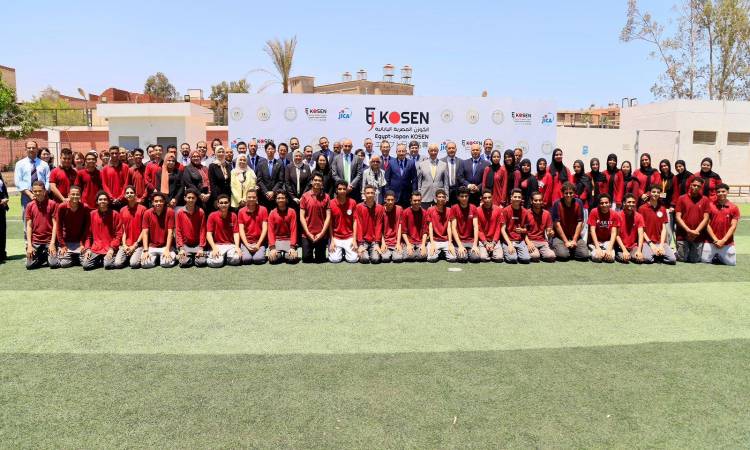
Mohamed Abdel Latif, Egypt’s Minister of Education and Technical Education, alongside Dr. Abdel Aziz Qansoua, Minister of Higher Education and Scientific Research, and Yuko Mitsui, Vice President of the Japan International Cooperation Agency (JICA), conducted an official visit to the Kouson Egyptian-Japanese Institute in El Obour City. This visit aimed to monitor educational processes and training activities at the institute.
This initiative is part of strengthening the strategic partnership between Egypt and Japan in advancing technological education.
The delegation included Ambassador Faiza Abou el-Naga, National Security Advisor to the President; Dr. Rasha Sharaf, Secretary General of the Education Development Fund; Dr. Hani Helal, Secretary General for Egyptian-Japanese Educational Partnership; Dr. Ayman Farid, Assistant Minister of Higher Education; Dr. Ahmed El-Gohary, former president of the Egyptian Japanese University for Science and Technology; along with other representatives from JICA and faculty members from the institute.
During the visit, Minister Abdel Latif expressed his pride in the innovative advancements at Kouson Institute, highlighting its embodiment of Egypt’s vision for developing technical education systems that meet global competitiveness standards.
He praised the educational philosophy underpinning Kouson’s curriculum which integrates Japanese quality standards with problem-solving-based applied learning (STEM), emphasizing continuous improvement in academic performance. The institute has successfully created unique technological pathways that serve national industry sectors including computer science, smart robotics, green energy, and microelectronics while addressing skill gaps between engineers and technicians.
Minister Qansoua reiterated that Kouson embodies exceptional cooperation between Egypt and Japan in technological education. He noted its role in preparing qualified technical personnel aligned with modern educational frameworks to meet labor market needs while supporting sustainable development goals.
He added that there is significant focus on enhancing technological education systems through international partnerships. The collaboration with Japan has led to pioneering educational projects such as the Egyptian-Japanese University for Science and Technology and Kouson Institute—models for knowledge transfer and human capacity building that bolster Egypt’s position as a regional center for education and innovation.
Mitsui expressed her appreciation for ongoing collaboration between Japan and Egypt in education. She affirmed that Kouson serves as an exemplary platform for transferring Japanese expertise in advanced engineering and manufacturing innovation aimed at producing capable technical professionals across various industrial sectors.
She emphasized continuous development within this educational partnership while noting successful joint projects reflect mutual trust between both nations. JICA looks forward to further cooperation with Egyptian institutions to enhance human resource preparation by transferring Japanese knowledge in technological education, innovation, and industrial development.
In her remarks, Dr. Rasha Sharaf highlighted that Kouson is one of the most strategic projects under the Education Development Fund’s umbrella—reflecting its vision to innovate educational models based on international partnerships linking education with production.
She mentioned efforts are underway to expand Kouson’s model across Egypt through active collaboration with international partners like JICA while involving industry stakeholders contributing towards achieving sustainable development goals by building a skilled workforce ready for future challenges.
The visit included a detailed presentation by Dr. Ahmed Al-Bandari about Kouson’s philosophy which connects theoretical knowledge with practical application through simplified sciences fostering students’ creative skills while thanking both ministers along with their Japanese counterparts for their unwavering support towards enhancing institutional capacities.
A tour within the institute showcased laboratories and training workshops where students demonstrated their projects reflecting significant progress made under Japan’s educational technology model implemented within Egypt’s context. The event also featured a theatrical performance titled “History of Egypt,” presented by students alongside practical experiments in chemistry and physics as well as student-led projects focusing on software development robotics applications artificial intelligence among other scientific disciplines.
The duration of study at Kouson Institute spans five years during which it awards an advanced technological diploma across several modern specializations catering directly towards labor market demands including artificial intelligence computer science robotics mechatronics green energy solar panel technology microelectronics—all adhering strictly following Japanese integrated academic training methodologies.
Comments